The Power of Believing that You Can Improve
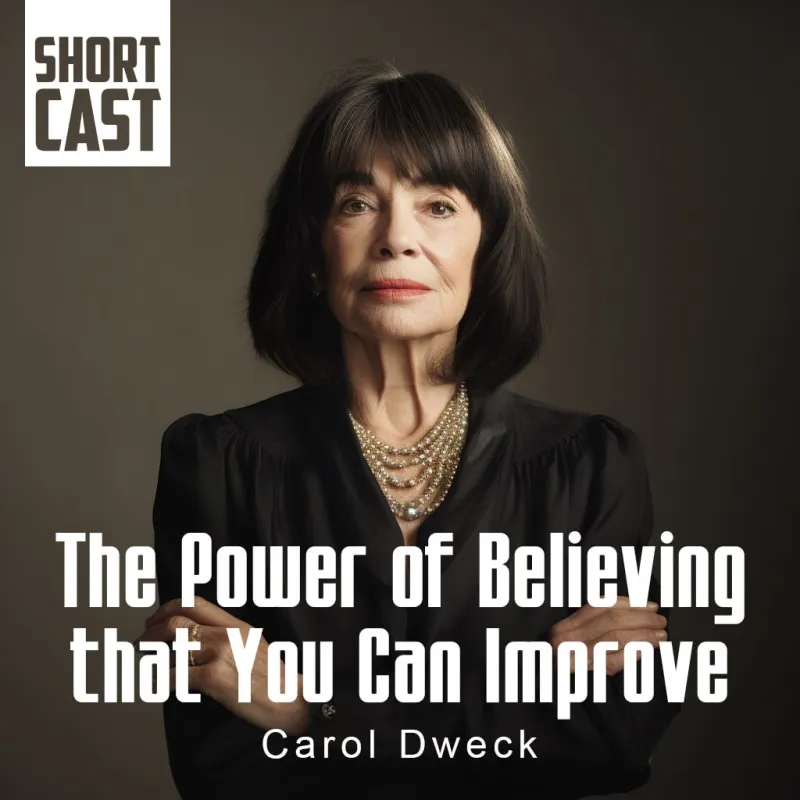
Welcome back, incredible BookDuck fans! Everyone wants to be better than they are at the moment. Especially students who want to be the best and get the highest grades. But is such a desire a good one? Today Carol Dweck will tell us about the power of believing that you can improve
Carol started her speech on Ted Talk by explaining the power of yet. Here’s a story that happened in a high school in Chicago where students had to pass a certain number of courses to graduate, and if they didn't pass a course, they got the grade "Not Yet." And Carol thought that was fantastic, because if you get a failing grade, you think, I'm nothing, I'm nowhere. But if you get the grade "Not Yet", you understand that you're on a learning curve.
It gives you a path into the future.
"Not Yet" also gave an insight into a critical event early in Carol’s career, a real turning point. She wanted to see how children coped with challenges and difficulty, so she gave 10-year-olds problems that were slightly too hard for them. Some of them reacted in a shockingly positive way. They said things like, "I love a challenge," or, "You know, I was hoping this would be informative." They understood that their abilities could be developed. They had what she calls a growth mindset.
But other students felt it was tragic, catastrophic. From their more fixed mindset perspective, their intelligence had been up for judgment, and they failed. Instead of luxuriating in the power of yet, they were gripped in the tyranny of now.
So what do they do next?
In one study, Students told Carol and her colleagues they would probably cheat the next time instead of studying more if they failed a test. In another study, after a failure, they looked for someone who did worse than they did so they could feel really good about themselves.
And in study after study, they have run from difficulty.
How are we raising our children?
Are we raising them for now instead of yet? Are we raising kids who are obsessed with getting A-s? Are we raising kids who don't know how to dream big?
Their biggest goal is getting the next A or the next test score.
And are they carrying this need for constant validation with them into their future lives? Maybe, because employers are coming and saying,
"We have already raised a generation of young workers who can't get through the day without an award."
So, how can we build that bridge to ‘yet?’
Here are some things we can do. First of all, we can praise wisely,
not praising intelligence or talent.
That has failed. Don't do that anymore.
But praising the process that kids engage in, their effort, their strategies, their focus, their perseverance, and their improvement. This process of praise creates kids who are hardy and resilient.
There are other ways to reward yet.
Game scientists from the University of Washington created an online math game that rewarded yet.
In this game, students were rewarded for effort, strategy, and progress.
The usual math game rewards students for getting answers right, right now, but this game rewards a process.
And teachers got more effort, more strategies, more engagement over longer periods of time, and more perseverance when they hit really, really hard problems.
Just the words "yet" or "not yet," teachers are finding, give kids greater confidence, and give them a path into the future that creates greater persistence. And we can actually change students' mindsets. In one study, students were taught that every time they push out of their comfort zone to learn something new and difficult, the neurons in their brain can form new, stronger connections, and over time, they can get smarter.
And guess what this study led to?
Students who were not taught this growth mindset continued to show declining grades over this difficult school transition but those who were taught this lesson showed a sharp rebound in their grades.
We have shown this now, this kind of improvement, with thousands and thousands of kids, especially struggling students.
The next topic is equality.
In the USA, there are groups of students who chronically underperform, children in inner cities, or children on Native American reservations.
And they've done so poorly for so long that many people think it's inevitable.
But when educators create growth mindset classrooms steeped in yet,
equality happens.
And here are just a few examples.
In one year, a kindergarten class in Harlem, New York scored in the 95th percentile on the national achievement test.
Many of those kids could not hold a pencil when they arrived at school.
In one year, fourth-grade students in the South Bronx, way behind, became the number one fourth-grade class in the state of New York on the state math test. In a year and a half, Native American students in a school on a reservation went from the bottom of their district to the top, and that district included affluent sections of Seattle.
So the Native kids outdid the Microsoft kids. This happened because the meaning of effort and difficulty was transformed.
Before, effort and difficulty made them feel dumb, made them feel like giving up, but now their neurons are making new and stronger connections.
That's when they're getting smarter.
At the end of her speech, Carol spoke about the letter she received from a 13-year-old boy.
He wrote, "Dear Professor Dweck, I appreciate that your writing is based on solid scientific research, and that's why I decided to put it into practice. I put more effort into my schoolwork, into my relationship with my family, and into my relationship with kids at school, and I experienced great improvement in all of those areas. I now realize I've wasted most of my life."
In conclusion, let's not waste any more lives, because once we know that abilities are capable of such growth, it becomes a basic human right for all children, to live in places that create that growth, to live in places filled with "yet".