Section 1
Once upon a time, there existed a destitute man who was no longer capable of providing for his sole son. The son expressed, "Beloved father, our circumstances are so unfavorable that I am becoming a hindrance to you." "I would prefer to depart and explore opportunities to earn my livelihood," the son proposed. The father granted him his approval, bidding him farewell with immense sadness. During that period, the ruler of a powerful kingdom was engaged in a conflict, and the young man enlisted in his army, accompanying him into battle. Upon confronting the adversary, a fierce battle ensued, and peril was imminent as ammunition poured down and his comrades were falling on all fronts, eventually, the leader of their army was also slain, and the surviving soldiers were preparing to flee, however, the young man took a bold step forward, addressing them with confidence and exclaiming, "We shall not permit our homeland to be destroyed!" Subsequently, his peers followed his lead, and he advanced onward to triumph over the opposing forces. Upon learning that the young man was solely responsible for their victory, the King elevated him above all his comrades, bestowed upon him significant riches, and appointed him as the highest-ranking individual in the entire realm.
The King possessed a remarkably gorgeous daughter, yet she possessed peculiar tendencies. She had sworn to wed no one who did not pledge to be buried alive with her in the event of her demise preceding his. "If he truly loves me with every fiber of his being," she declared, "what good would life be to him after my passing?" In return, she pledged to reciprocate the same vow. If he were to pass away before her, she would follow him into the grave. Hitherto, this peculiar pledge had deterred all suitors, yet the young man was so enamored by her attractiveness that he disregarded any reservations and solicited her father's approval. "Art thou aware of what thou art required to pledge?" inquired the King. "I must commit to being buried with her," he responded, "even if I outlive her. Nonetheless, my love for her is so immense that I do not fear the peril." Thereupon, the King granted his permission, and the couple's nuptials were celebrated with magnificent grandeur.
For a period, they lived joyfully and satisfied in each other's company. However, fate took a turn when the young Queen became severely ill, and no doctor could cure her. As she lay lifeless, the young King recalled the vow he had made and was terrified at the prospect of being buried alive, yet, he could not evade his obligation. The King had stationed guards at all the entrances, leaving no opportunity to elude his destiny. On the day of the funeral, he was escorted into the royal crypt with the Queen's body, and subsequently, the door was sealed and secured.
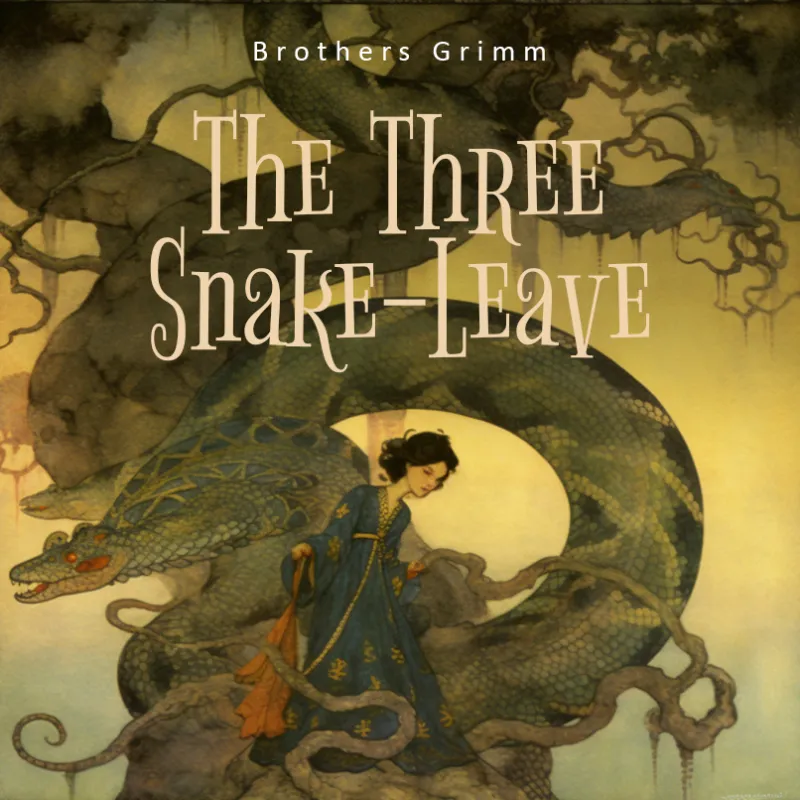
Adjacent to the casket rested a table embellished with four candles, four loaves of bread, and four bottles of wine, once this supply was exhausted, he would be left to perish from starvation. Thus, he remained seated, consumed by agony and sorrow, nibbling on small portions of bread and sipping tiny sips of wine each day, yet he watched death inching ever nearer. As he stared ahead, he observed a serpent slither out from a corner of the crypt and inch closer to the corpse. Assuming that it intended to feed on the Queen's remains, he unsheathed his sword and declared, "You will not lay a finger on her as long as I am alive," and struck the snake into three parts. Later, a second snake emerged from the crevice, but upon witnessing the lifeless form of its counterpart dismembered on the ground, it scurried away momentarily. Shortly thereafter, it returned holding three verdant leaves in its mouth, placing a leaf over each of the serpent's wounds, the pieces of the snake mended together, and it came back to life. The two snakes thenslithered off together. The leaves remained on the ground, and the despondent man, who had witnessed the miraculous revival of the snake, became curious about whether the magical leaves could also revive a human being. He took the leaves and placed one on his wife's mouth and the other two on her eyes.