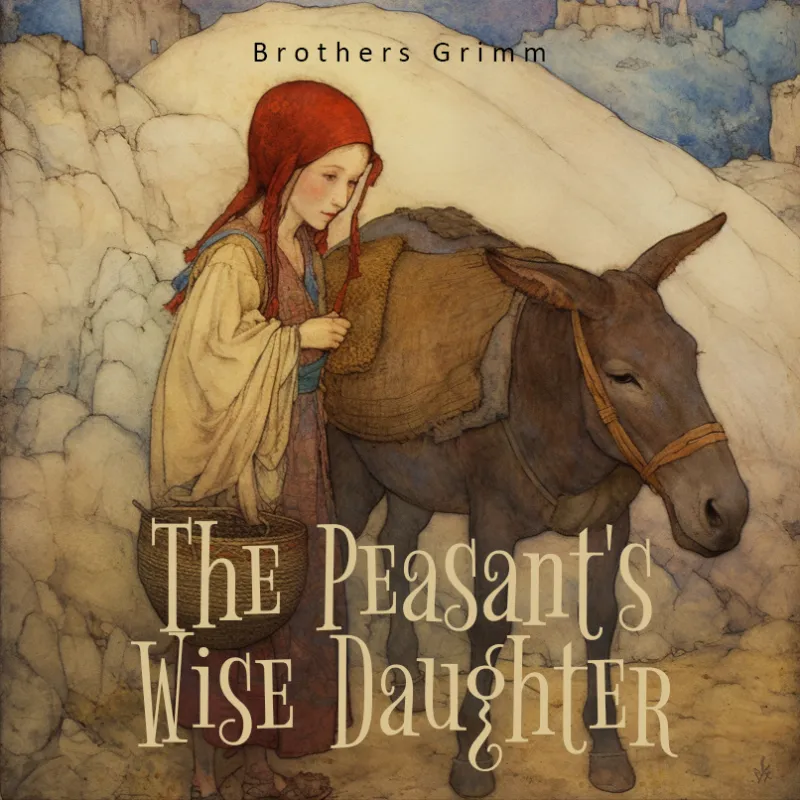
Section 1
Once there was a destitute farmer who possessed only a modest dwelling and a daughter, with no land of his own. The daughter suggested that they should request a piece of recently-cleared terrain from the ruling monarch. After learning about their impoverished situation, the king granted them a plot of land, which the father and daughter proceeded to cultivate by digging and planning to plant some corn and other grains. As they were nearing the completion of digging up the field, they stumbled upon a mortar crafted entirely out of gold within the soil. The father suggested to his daughter that since the king had been so kind in giving them the field, it would be fitting to offer him the golden mortar as a token of appreciation. On the other hand, the daughter disagreed with her father's proposal and replied, "Father, if we give away the mortar without having the pestle to go with it, we will have to acquire a new pestle. Therefore, it would be wise to keep quiet about our discovery." Despite his daughter's advice, the father chose not to heed her and brought the golden mortar to the king, explaining that he had discovered it on the cleared land and inquiring if the king would accept it as a gift. The king accepted the gift of the mortar and inquired if the farmer had discovered anything else during his excavation. The farmer replied in the negative.
The king then demanded that the farmer produce the accompanying pestle. The farmer replied that they had not discovered it, but his response fell on deaf ears, instead, he was arrested and thrown into prison, with the condition that he would remain there until he presented the pestle. The farmer was given the standard prison diet of bread and water, which was brought to him by the servants on a daily basis. They could hear him crying out constantly, expressing his regret, "Ah, if only I had listened to my daughter! Alas, if only I had heeded her advice!" He refused to eat or drink anything. Eventually, the king ordered for the prisoner to be brought before him, and inquired why the farmer was always heard lamenting, "Ah, if only I had listened to my daughter," and what it was that his daughter had advised him. The farmer then explained, "My daughter had advised me against bringing the mortar to you, saying that we would need to find the pestle too. If you have a daughter who is as wise as mine, I would like to meet her."
The king then summoned the farmer's daughter to appear before him and asked if she was truly as wise as her father had claimed, he proposed a challenge for her, saying that he would present her with a riddle, and if she could solve it, he would marry her. Without hesitation, the farmer's daughter agreed to take on the challenge. The king then presented her with the riddle: "Come to me neither clothed nor naked, neither riding nor walking, neither on the road nor off the road, If you can do that, I will marry you."
The farmer's daughter removed all of her clothes, wrapped herself in a fishing net, tied it to an ass's tail, and allowed herself to be dragged along, meeting all the criteria of the riddle. To meet the final condition of the riddle, the farmer's daughter had the ass drag her through the ruts, so that she only touched the ground with her big toe, thus fulfilling the requirement of neither being on the road nor off the road. Upon the farmer's daughter's arrival in such a unique manner, the king declared that she had successfully guessed the riddle and met all the necessary conditions.
The king ordered the release of the farmer from prison, married his daughter, and entrusted her with all the royal possessions.
After several years had passed, the king was inspecting his troops during a parade when a group of peasants selling wood stopped their wagons in front of the palace, with some using oxen and others using horses. One of the horses gave birth to a foal which then ran away and took refuge between two oxen in front of the wagon, belonging to a peasant who was selling wood outside the palace while the king was reviewing his troops on parade. As the quarrel grew louder and more violent, the king, who had been informed of the commotion, came out to see what was going on and asked the peasants to explain their dispute. The dispute was brought before the king, and he ruled that the foal should remain where it was found, which meant that the peasant with the oxen, who did not own it, ended up keeping it.