Section 1
A King had a daughter who was unbelievably gorgeous but who was also so arrogant and snobbish that no man was suitable for her. She mocked them as she rejected them one by one.
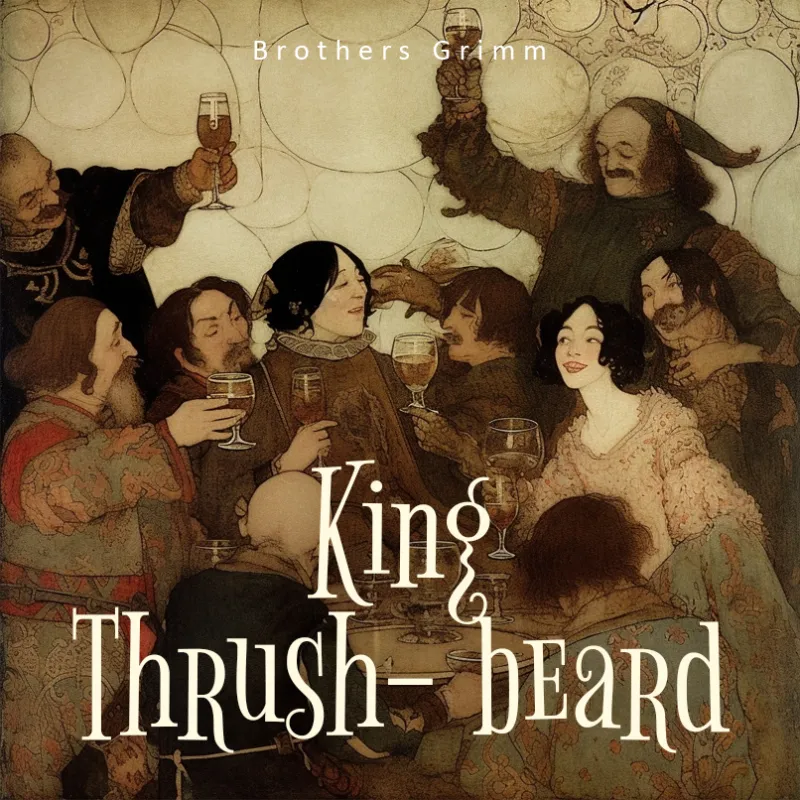
All the young men who were likely to get married were once invited to a large feast that the King had prepared. In accordance with their positions and ranks, they were all organized in a line; the kings came first, followed by the grand-dukes, the princes, the earls, the barons, and the nobility.
Afterwards, as she was being led through the ranks of men, the King's daughter objected to each person; one was overly fat, "The wine-cask," she said. Another was over six feet tall and "Long and thin has little in." Too little was said in the third: "Short and thick is never quick." The fourth was too gray—"As pale as death." Fifth too red: "A fighting-cock." The sixth, "A green log dried behind the stove," wasn't structured straight enough.
She therefore had something negative to say about everyone, but she was particularly delighted with a good king who was seated pretty high in the row and whose chin had developed a slight curve. She exclaimed, laughing, "Well, he has a chin like a thrush's beak!" Consequently, he began going by the name King Thrushbeard.
Other than the old King became furious and swore that she should marry the first beggar who knocked on his door after witnessing that his daughter had done nothing except scorn everybody and resent every potential husband who had gathered there.
A fiddler performed beneath the windows a few days later in an effort to collect some tiny gifts. After hearing him, the King commanded, "Let him come up." The fiddler entered the room wearing shabby, torn clothing and performed a song for the King and his daughter before asking for a little gift. "Your song has made me feel so good that I will give you my daughter there to become your wife," the King declared.
The daughter of the King winced, but the monarch declared, "I have taken a vow to give you to the very first beggar, and I am going to keep it." All of her words were pointless since the priest was called, forcing her to instantly consent to the fiddler's marriage. The King then remarked, "Now that has been done, it is not acceptable for you, a beggar-woman, to live in my palace any longer; you may just leave with your husband."
She was forced to go on foot with the beggar-man as he guided her out by the hand. She inquired, "To whom does that beautiful forest belong?" when they arrived at an enormous forest areas. If you had taken King Thrushbeard, it would have been yours because it belongs to him. "Oh, what a miserable girl I am, if only I had taken King Thrushbeard!"
When they arrived at an open field later, she inquired once more, "To whom does this lovely green meadow belong?" "If you had taken King Thrushbeard, it would have been yours because it belongs to him." "Oh, what a miserable girl I am! If only I had taken King Thrushbeard!"
Once more, she inquired as they approached a big town, "To whom does this fine large town belong?" "If you had taken King Thrushbeard, it would have been yours because it belongs to him." "Oh, what a miserable girl I am! If only I had taken King Thrushbeard!"
The fiddler expressed displeasure, asking, "Am I not good enough for you to listen to that you always wish for another husband?" Finally, they arrived at a tiny cabin, and she said, "Oh goodness! What a little abode! Who is the owner of this pitiful, depressing shack?" "That is my house and yours, where we will live together," the violinist replied.
The low door required her to bend in order to enter. The King's daughter asked, "Where are the servants?" The beggar-man responded, "What servants? You must carry out your wishes yourself. I'm quite weary, so just start a fire right now and boil some water to prepare my dinner." However, the beggar-man had to help himself in order to get anything done effectively because the King's daughter had no experience with cooking or starting fires. They went to bed after finishing their little dinner, but he made her wake up early the next morning to take care of the house.
They did this for a couple of days, as well as they could, until they ran out of everything they had. Then he remarked to his wife, "Wife, we can no longer dine and drink here while earning nothing. Your craft is basketry." He cut some willows outside and brought them inside. She then started weaving, but the sharp willows cut through her soft hands.