Section 1
There was a Brahman who was extremely poor. He had a wife and four children, and their survival depended largely on the charity of the wealthy. The Brahman's main sources of income were the gifts he received when marriages or funeral ceremonies took place. However, since these events did not occur every day, he struggled to make ends meet. His wife often criticized him for not being able to provide enough for the family, and his children suffered from hunger and lack of clothing. Despite his poverty, the Brahman was a virtuous man. He was diligent in his religious practices, and every day he would devoutly pray at specific times. His chosen deity was the goddess Durga, who was believed to be the creative force of the universe and the consort of Siva. Before consuming any food or water each day, he would write the name of Durga in red ink at least 108 times. Throughout the day, he continuously called upon Durga for mercy, repeating the phrase "O Durga! O Durga!" Whenever he felt distressed about his poverty and his inability to provide for his family, he would cry out in anguish, "Durga! Durga! Durga!"
The Brahman, overwhelmed by sadness, ventured into a distant forest, far from his village. In the depths of his sorrow, he shed bitter tears and offered a prayer in the following words: "O Durga! O Mother Bhagavati! Will you not bring an end to my misery? If I were alone in this world, poverty would not sadden me. But you have blessed me with a wife and children. Mother, grant me the means to support them."
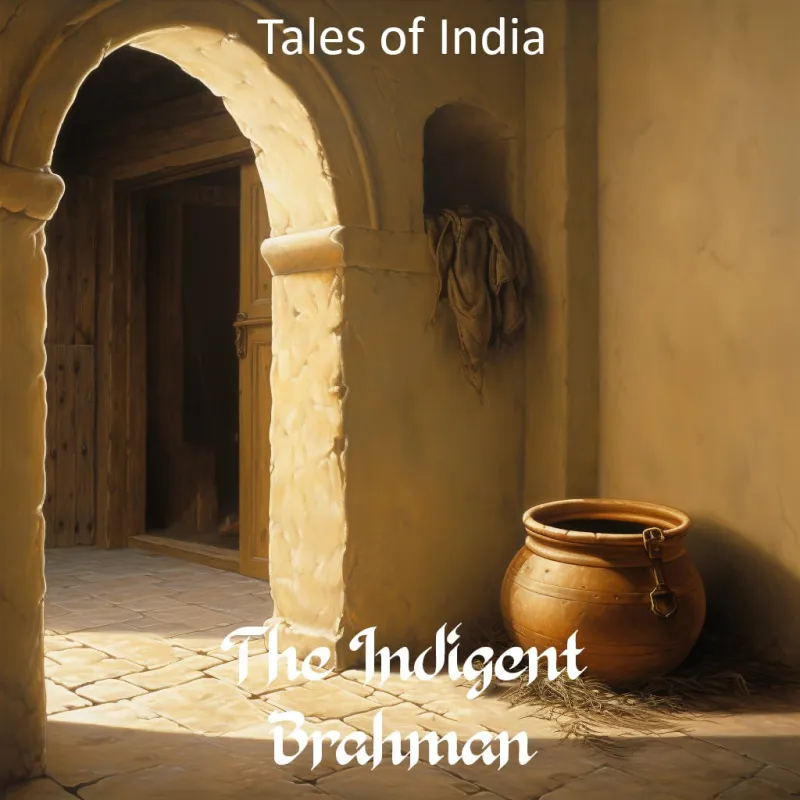
Coincidentally, on that very day and in that very spot, the god Siva and his wife Durga were strolling together. Observing the Brahman from a distance, Durga spoke to her divine husband, saying, "O Lord of Kailas! Do you see that Brahman? He constantly utters my name, seeking deliverance from his troubles. My lord, can we not do something for this poor Brahman, burdened by the responsibilities of his growing family? Let us provide him with enough to bring him comfort. As the poor man and his family never have enough to eat, I suggest you grant him a 'handi' that will yield an endless supply of mudki." The Lord of Kailas readily agreed to his divine consort's proposal and, by his decree, created a handi with the desired quality right on the spot. Durga then called the Brahman to her and spoke, "O Brahman! I have often contemplated your pitiable state. Your repeated prayers have finally stirred my compassion. Here is a handi for you. When you invert it and shake it, it will continuously pour the finest mudki, without ceasing, until you return the handi to its proper position. You, your wife, and your children can eat as much mudki as you desire, and you may also sell as much as you wish."
The Brahman, overjoyed to receive such an invaluable treasure, expressed his gratitude to the goddess. Taking the handi in his hands, he hurriedly made his way back to his house. However, after only a few yards, he felt the urge to test the extraordinary vessel's effectiveness. Thus, he turned the handi upside down and shook it, and to his amazement, a quantity of the finest mudki he had ever seen fell to the ground.
He wrapped the sweetmeat in his cloth and continued walking. By noon, the Brahman began to feel hungry, but he knew he couldn't eat without first performing his ablutions and prayers. Spotting an inn along the way, with a tank not far from it, he decided to stop there to bathe, offer his prayers, and finally enjoy the much-awaited mudki. The Brahman sat at the innkeeper's shop, keeping the handi close to him. He smoked tobacco, applied mustard oil to his body, and before heading to the nearby tank for his bath, he entrusted the handi to the innkeeper, emphasizing the need for its careful protection.
As the Brahman went to perform his bathing and prayers, the innkeeper couldn't help but find it curious how the Brahman seemed so concerned about the safety of his clay vessel. He wondered if there might be something valuable inside the handi, as otherwise, why would the Brahman be so attentive to its well-being?